
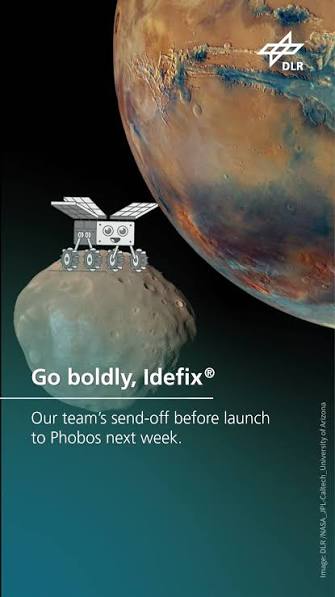
There has always been an inherent connection between taming space and adventuring on the wide open road. These two domains moved closer as Tesla unveiled a new Roadster fitted with winged rocket thrusters and the Japanese launched a lunar mission with “Idefix” on board.
Once the spacecraft lands on a Martian moon, Idefix, the rover, will need to bounce or fly in ultra-low gravity, flip and roll over, and use batteries to power up. Like the Roadster prototype, this rover pushes new boundaries.
This crossover of cars and space travel is not so new. In the 1970s, NASA deployed three electric lunar roving vehicles. They remain on the moon. When the Apollo astronauts returned to Earth, GM presented them with custom Chevrolet Corvettes. That permanently bonded the glamour of space exploration to high-performance cars.
Reactions this week for the space-age Roadster were met with both skepticism and awe (say if you search on Reddit). That’s not surprising, but awe should win- the- day, for these reasons:
I. Let’s Play! (Toys for Boys):
Vehicles that are “expensive playthings” have a long history. In the late 19th century horseless vehicles were novelties raced by inventors and wealthy businessmen. It is easy to imagine the bewilderment when the public encountered a carriage moving on its own volition. Hence the name that stuck, a horseless carriage.
Into the twentieth century, horses continued to handle the labor: pulling plows, transporting freight, and delivering the mail. But the early enthusiasts laid the groundwork for Henry Ford. It anticipated the supply chains, manufacturing, and paved roads for modern transportation.
There is a similar trajectory in the history of mobile telecommunications.. For over two decades, cellular phones were “toys for (wealthy) boys.” Early car phones were suitcase sized, cost thousands of dollars, and were routinely dismissed as unnecessary.
Over time, the military came to depend on mobile communications more and investors provided the capital needed to build out cell towers. Yesterday’s “boy toy” laid the foundation for the smartphones we depend upon today.
II. Interesting Engineering:
A popular site called Interesting Engineering covers all aspects of technology. They will eventually pay homage to the “thruster car.”
While a winged, thruster-assisted roadster might seem gimmicky, motorsport racing has long functioned as a lab for pushing boundaries. The Tesla prototype may find a home in high-profile electric racing formats like Formula E or the all-electric E1 powerboat championship. To improve speeds, the thrusters may help to re-balance aerodynamics, weight distribution, or energy delivery.
Such advancements usually filter down to everyday vehicles. Tesla has repeatedly demonstrated how eccentric engineering experiments can yield practical benefits. The first roadster, circa 2010, kicked off Tesla’s entry into battery powered cars, then battery swaps, and finally, the development of the Supercharger network.
Even the unconventional, often maligned Cybertruck, has become a real-world testing ground. Demonstration of the vehicle’s high-voltage electronics and single piece stamping are expected to improve conventional assembly lines.
III. EVs Are the Future — Gas Is Not, Horses are Gone Gone:
There are polarized opinions about the Tesla “thruster car”: some see them as another Elon Musk attention-grabbing stunt and others recognize it as a gateway for EV futures.
Leaning into the latter, the Roadster keeps EVs from descending into a dry, dull space. The Chinese already grasp this. During the 2026 Paris Auto Show, much of the buzz centered around playful car interiors such as built-in karaoke systems, automated beverage stations, and external projector headlights. The Chinese manufacturers reframed the EV as a “fun “ driving space.
The Tesla roadster centers on the exterior, the real engineering, and elevates “fun” (literally). It will not be built for the average grocery run. But just as cars once replaced the horse, this next iteration replaces horsepower entirely.