
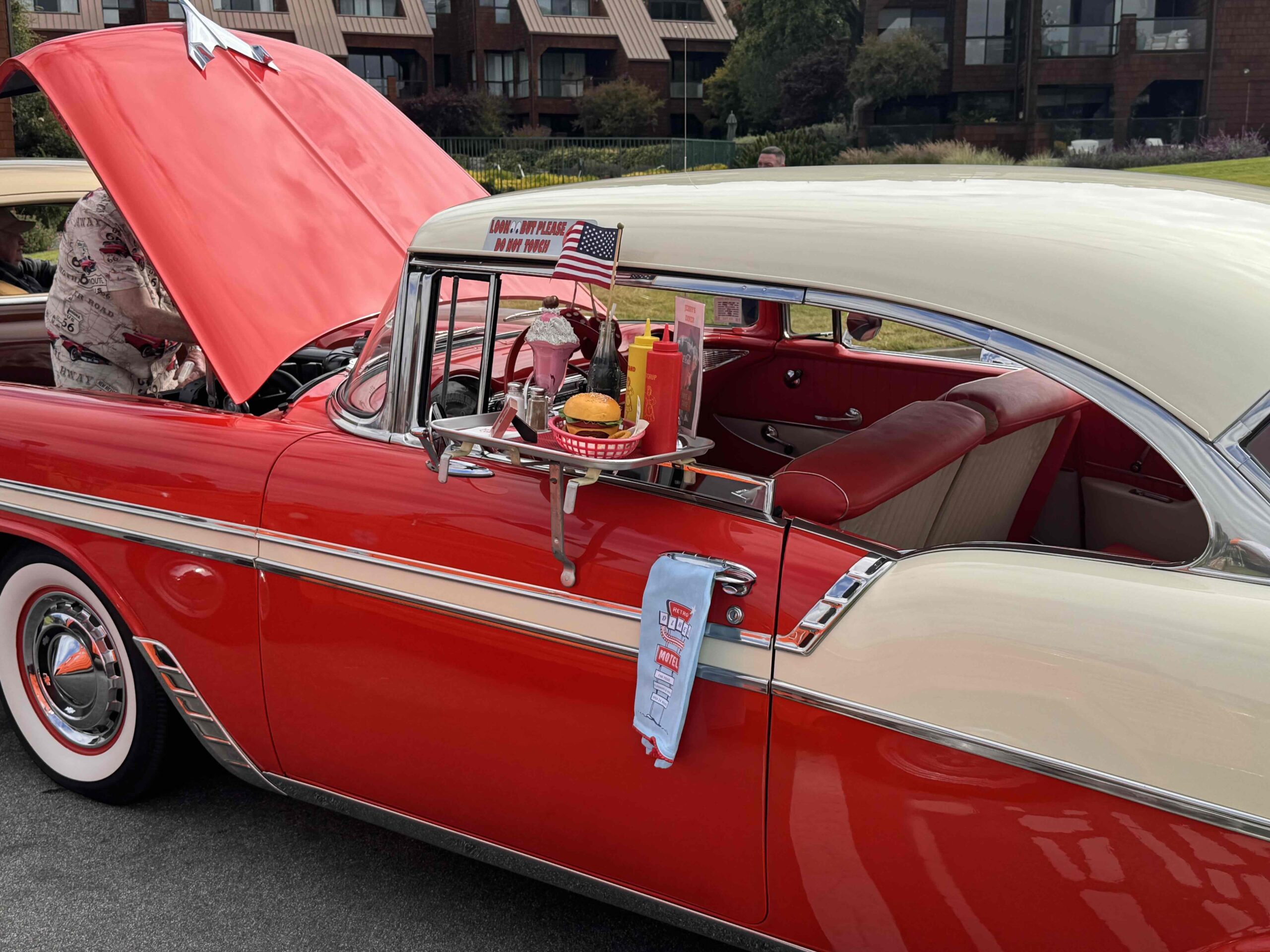
The Car Show was born in an era when making a vehicle fast, loud, and uniquely yours was the ultimate expression of cool. It’s a good time to ask how they will evolve since they are a staple of summer weekends, as iconic as picnics and peach cobbler. With more and more EVs and self driving cars do CarShows go the way of the drive-in theater, or evolve into something else?
Today’s shows, as well as many of the spectators, hail from the 1930s, ’50s, and ’60s. These were times when customization was king.
But what about the next generation? Will father/son teams work together to modify their electric vehicle (EV)? Will kids who at today’s shows get excited to pursue a career in automotives?
The “Phone on Wheels” Problem
The likely answer is that Car Shows have to reboot, because the modern EV is a homogenized package that resists modification. Often described as a “phone on wheels,” EVs operates more like a rolling computer than an internal combustion machine. Mechanically, they are shockingly simple. An EV drive train contains only about 20 moving parts compared to the 2,000-plus found in a gas engine.
As a result, performance from mechanical engineering to software optimization. EV hobbyists search for (see ad) “ghosts in the machine”, that is, commercial software that augments factory equipment.
But that creates a conflict with manufacturers, who lock-down the Digital Rights Management (DRM). Even changes to the exterior can be problematic: swapping to non-aerodynamic wheels or altering the ride height changes the coefficient of drag. That penalizes range and potentially voids the warranty.
Bragging Rights: Efficiency is the New Horsepower
Traditionally, the most important “show and tell” at Car Shows was not the paint job, but the power. The muscle cars of the 1960s were obsessed with raw speed and 0-to-60 mph times. But what happens when EVs have already surpassed those metrics?
The new goal is efficiency and aerodynamics. You only have to look at Formula E racing for inspiration, where the winning vehicles use algorithms and code to lower watt-hours per mile (Wh/mi).
Squeezing a 10% range extension out of a battery through aerodynamic tweaks or custom thermal management is the modern equivalent of gaining 50 horsepower. But this efficiency presents an existential problem for the Car Show: how do you show off a line of code or a drag coefficient? Posters anyone?
How the Car Show Survives
So far, EV owners are finding other ways to brag. Trunks and frunks are on display to demonstrate vehicles that function as mobile, self-sustaining power stations. For example, Rivians demonstrate they are the partner for camping adventures and the Ford Lightning (now discontinued) can power up tools at a work-site.
And there’s hope! The upcoming Slate truck, the so-called Model T of light-duty trucks, is promising (per this J. Leno interview) a hands-on, personalized experience. More like an Ikea, Slate will sell flat-pack, DIY customization kits.
For now, in the summer of 2026, there are a lot of older cars, enthusiastic drivers, and fun to be had at Car Shows. But it’s not clear where future events are headed, as personal transportation shifts from carburetors to code.