
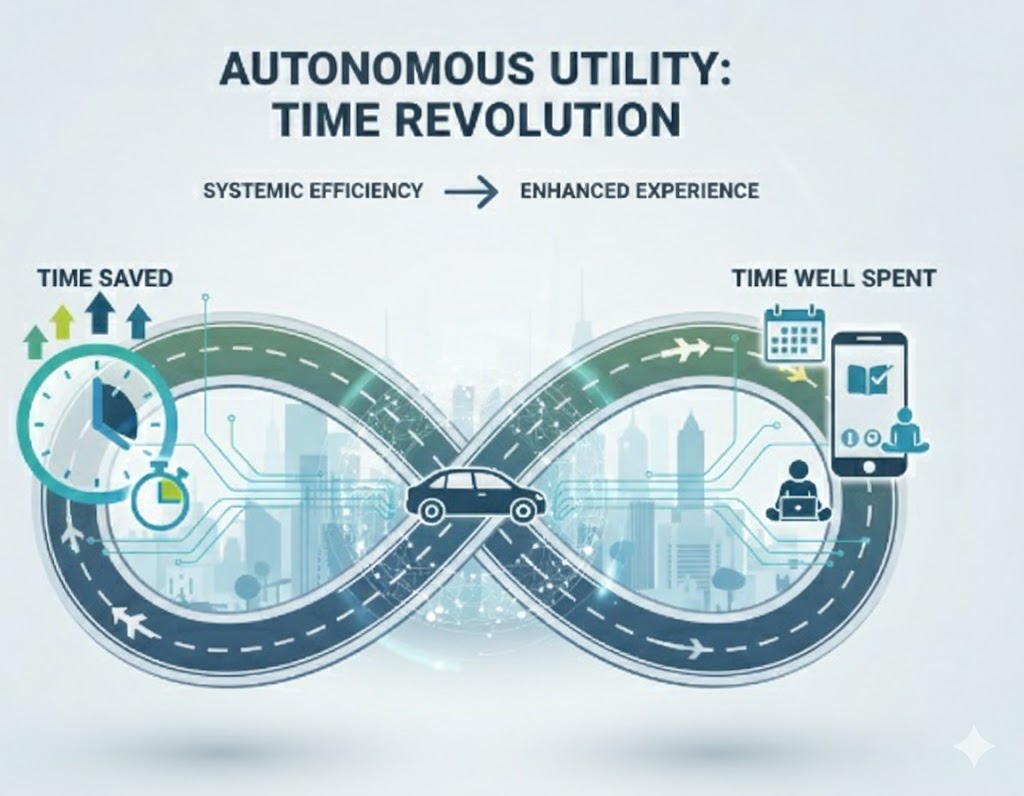
For decades, transportation planning has focused on a core metric: getting people from Point A to Point B with maximum efficiency. We optimize for utility, comparing the personal car to public transit on the basis of “Time Saved.”
But the autonomous vehicle (AV) revolution demands a more sophisticated model. It’s not just about the clock anymore; it’s about “Time Well Spent.”
The autonomous vehicle fundamentally shifts the competitive nature of the mode mix by introducing two characteristics that fundamentally change travel utility:
- Computational Time Saved (Systemic Efficiency): Optimized routes, platooning, and fewer human-error delays.
- Time Well Spent (The Travel Experience): Productivity, entertainment, or leisure during the journey.
📱 The “Smart-Companion” Effect: AVs as Personal Mobility Utilities
The AV’s structural change to transportation mirrors the evolution of the smartphone. Like the transition from fixed wall phones to mobile devices, autonomous vehicles decouple mobility from an ownership burden, making it:
- On-Demand: Ready when needed, not sitting idle 95% of the time.
- Spontaneous & Light: A service, not an asset burdened by monthly payments, insurance, and maintenance costs.
Telecommunications and travel are complements, not substitutes. This relationship was observed some time ago in a seminal paper by transportation planner Ilan Salomon . He noted a third outcome- that technology would also modify the type of travel taking. The nature of that modification is just beginning to take shape and form.
The New Utility: Travel-as-Experience (TxE)
The ability of the AV to provide an end-to-end travel experience is the true disruptor for the logistics and leisure sectors. The future of the trip isn’t just a commute; it’s a seamless, pre-programmed experience:
- Proactive Planning: AI-driven learning will manage complete itineraries, recommending salient stops (dining, visits, stays) en route.
- Integrated Logistics: The vehicle handles booking, ticketing, unanticipated delays, and schedule adjustments autonomously.
- “Bleisure” Enablement: It formalizes the blend of work and leisure that younger, mobility-as-a-service (MaaS) users already value.
This shift transforms the AV away from point- to-point trips into a dynamic, itinerary-based concierge.
The Missing Component: Travel as Well-Being
For transportation professionals, the path forward is clear, but one critical component remains: trust and safety assurance.
To unlock the full potential of AVs—and the subsequent efficiency gains in logistics and reduction in road maintenance—we must transition the public mindset from viewing the traditional car as a status symbol to recognizing its current role as a machine contributing to ∼42,000 traffic fatalities annually in the U.S. alone.
The greatest systemic utility of AVs is the elimination of human error. This requires a shift in attitude and robust regulatory frameworks that unequivocally prove the “Well-Being” utility—that the autonomous mode is statistically, demonstrably safer.
The Future of the Mode Mix
As AVs absorb long-haul, on-demand, and last-mile connections, expect a boost in the utility of non-vehicular modes. Safer, less congested urban cores will see micromobility (e.g., e-bikes, scooters) and pedestrian travel gain prominence due to improved access, safety, and overall accessibility.
The AV era isn’t the end of transportation; it’s a renaissance of choice—where every mode, from walking to Level 5 autonomy, operates at a higher potential utility.