
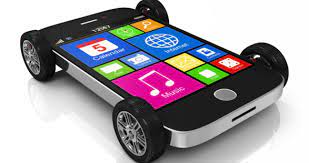
The fact that the sexiest, most talked about car in China has roots in the telecommunications industry is not a footnote—it’s a roadmap. Xiaomi has become a major electric vehicle player, along with Huawei and ZTE. These three Asian firms are not tied to our 125 year old Model T assembly line.
The telecom-centric car is becoming a reality in automotives. And we might hope that a U.S. company with experience, perhaps Apple or AT&T, will jump back in to succeed. Recently, Japan’s telecommunication group, NTT, announced they were all- in on autonomous buses and taxis.
The Networked Drive
The networked environment is key. It’s useful to remember that the telecommunications system, either wired or unwired, requiredssynergy. The more a telecom network grows, the greater the advantage to users. As more users join the network, the network continues to upgrade and improve, and that brings in more users. It’s network synergy.
Until now, paved roads and gas stations have functioned as the “network” for operating gas vehicles. It’s changing. Electric cars that engage in autonomous driving need a network of connected traffic signals, road alerts, and for the future, connection to other vehicles. A “Car-to-Grid” and “Car-to-Car” communication turns the vehicle into a node within a massive, interconnected network, similar to telecommunications.
There is a significant network advantage that will bring even greater fusion between the smartphone and the electric car. It hasn’t quite happened yet. Perhaps you use a small electronic pad, without a plug, to wirelessly charge up your phone or other electronics. You find it easy, convenient, and reliable. Now imagine a car driving over a larger electronic plate and restoring the energy for its lithium battery.
Cars are not driving over these wireless plates in any number yet, but electricity is everywhere, and coming for them soon. The telecommunications company just got there first.
The Battery Advantage
A prime reason that telecom firms have a massive head start begins with their deep-rooted experience with lithium batteries. They have scoped out the mineral-intensive supply chain and have long term contracts for raw materials. They are also heavily invested in R&D to improve the batteries, both for small consumer devices and large commercial products. The familiar 12-volt battery—used since 1912— is literally, a lead weight.
A key requirement is expertise in thermal management software. That is needed to reduce the risk of fire and condition lithium based batteries to survive extreme temperatures. While a legacy automaker might have 125 years of experience perfecting the combustion engine and that 12 volt battery, this requires a new science.
The telecom and phone companies also have a great advantage reaching scale. Once vehicle batteries are spent, they know how to recycle and recapture the “black mass”, the goldmine of minerals inside each battery. Recycling shortens the supply chain and reduces the cost for the next cycle of battery production.
Software and Subscriptions Outrank Style
If you have a smartphone that is two years old…or ten, it won’t shout its age or look particularly dated. Most phones look alike so it’s software updates that keep them going.
That’s a contract to legacy car manufacturers. They have long focused on “annual style changes”—tinkering with the exterior look to encourage customers to trade in for the latest model. A tech approach is different. Tesla and its successors have demonstrated a longer consumer life cycle because the vehicle’s value is preserved through over-the-air software updates. Much like a smartphone, which we refresh every few years to gain better camera or video quality, an EV evolves while it sits in your driveway.
It’s already on the move. Some vehicles are now available with a subscription service that keeps them ever-modern and state-of-the-art. It’s similar to the contract you hold with a cell phone provider, who likes to sell you add-ons and extras. Both the phone and your car are network-connected. It’s a synergy that only grows.