
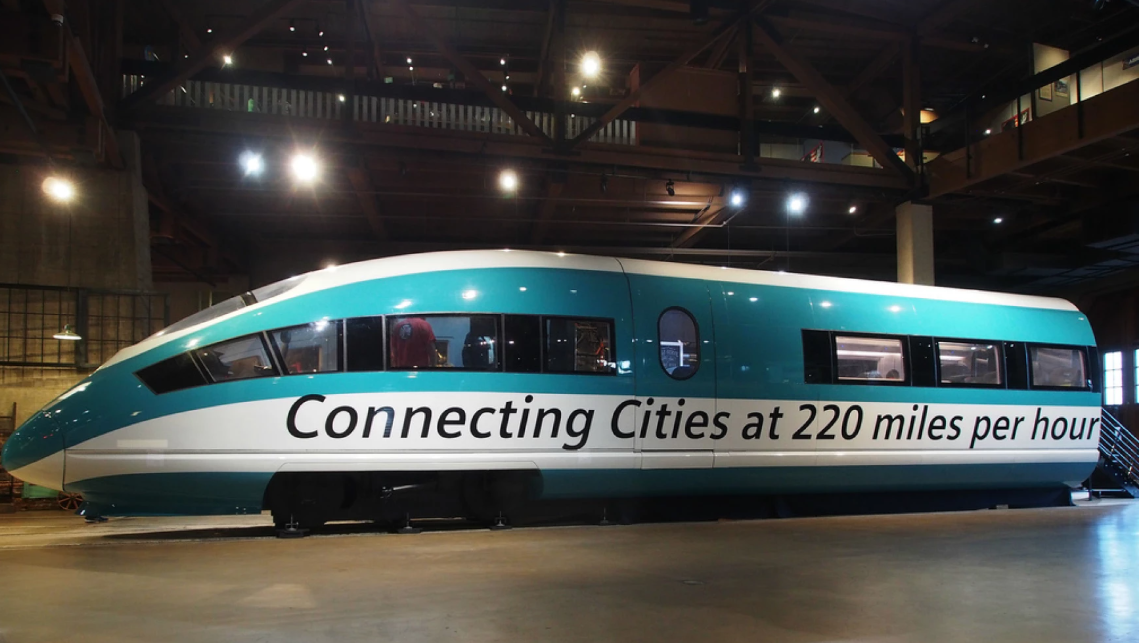
The California high speed rail, the $100 billion build-out that has yet to complete its 500 mile run would not seem to have much in common with electric vehicles. It’s a coincidence but in 2011, three years after voter approval for the train project, Tesla and Nissan introduced their first EVs in California. Today, electrics represent about 25% of new vehicle sales and the rates are nearly double in urban areas. It’s plausible that the launch of EVs would have taken longer and fewer would have been sold if the California high speed rail had succeeded. Here’s why the California High Speed Rail Helps Electric Vehicles.
While most car buyers get a new (or used) car based on their daily transportation needs, that’s not how they shop for one. Shopping is “aspirational”. Buyers within most price ranges anticipate travel adventures. So, in addition to the daily grind there’s “destination travel” – camping in national parks, a family reunion across the country, or racing at highspeed with instant torque. While these may be edge cases for most car buyers, choices are made with these in mind. In North America, this justifies buying larger, heavier vehicles that cost more and are less efficient, whether that’s electric or gasoline.
Elsewhere:
It’s a contrast abroad. In places with fast and reliable rail service drivers don’t need these larger vehicles. Imagine taking a trip- say from Tokyo to Nagoya, London to Birmingham, or Madrid to Toledo. Each country (Japan, England, and Spain) has a well-built road system to get around. But they also have high speed trains that make the journey- whether work or a vacation- a fast, pleasant, and cost-effective way to travel. The fare structure accommodates regular commuters and vacationing families.
Their mobility doesn’t stop at the train steps. Most European and Asian cities have mobility hubs that provide dependable ground level transit connections. Getting to and from a central city hotel, or even adding a journey to scenic outskirts can be completed without ridehail or driving alone.
The upshot is that when car shoppers from other countries select a new vehicle they are less inclined to shop for long distance travel and “edge” cases. That has helped EV sales abroad because extended range is not as critical. In 2023 (now an older statistic), 40% of the battery electric car sales in Europe were for small and medium models, contrasted with just 25% in the United States.
Side by Side -EV & Rail:
China provides some insight, where there are multiple EV models and high speed trains: China leads in EV production and also has one of the newest and fastest high-speed rail networks. In 2023, 50 percent of the electric vehicles sold there were small or medium in size. According to Chinese data published in Transport Policy, for distances over 300 km (186 miles) high speed rail is a strong competitor with cars, and for distances between 300 to 600 km and 600-900 km it is more popular than cars.
The U.S., with California, stands in sharp contrast. The availability of petroleum, its relatively low cost, and the robustness of interstate highways has curtailed demand for rail. It’s usually faster to fly between cities. But within cities, people need vehicles to get around. So, it’s often more convenient to just drive the entire trip. Californians do this in electric vehicles because there are a sufficient number of Level 3 charging stations along major freeways, and the Tesla brand, until recently, was a venerable (and aspirational) choice.
For now, California’s high speed rail has tipped the balance towards electric vehicles. Car shoppers have good reason to seek larger vehicles with longer range, if only for their occasional “edge” trip. In some perverse way, high speed rail drives the EV industry forward as battery makers develop longer range battery packs solely for North America and EV charging equipment reaches for faster speed. Some automakers, especially Toyota, are betting that hybrids are the better choice. But ultimately, pure battery electric vehicles, like the high speed rail, are what move people.