
It’s the next wave in automotive marketing, but it begs a strange question: what happens when an influencer passionately promotes a car they’ve never actually driven—and perhaps never even seen in person?
That provocative question lies at the heart of a fascinating article published last year in The Verge. It explores how car influencers are falling in love with Chinese electric vehicles (EVs), and how Beijing-backed platforms are loving them right back. Despite the article’s major implications for the auto industry, this story by Andrew Hawkins did not get as much mainstream attention as it deserves.
Two-Step is Not In-Step:
The time-tested “two-step flow” model of communication—where information moves from media to local opinion leaders, and then to the public—has fundamentally shifted. Influence no longer has to start with your neighbor trading stories over the fence or a savvy braggard hobnobbing at the water cooler. Instead, it begins with strangers we follow on TikTok and Instagram. They promote things big and small, but when it comes to cars, the stakes are massive. After all, transportation is generally our second-largest monthly household expense, right behind housing.
In theory, social media is a fantastic way to learn about a new vehicle. For many, it replaces the traditional car show. Let’s face it: attending a car show can be expensive, a massive time commitment, and it requires a boatload of walking. Replacing the car show with social media gives you instant access to the flash, the crisp videography, and the contagious excitement.
But as Hawkins/The Verge points out, many of these modern creators aren’t traditional automotive “gearheads” or sustainability-focused environmentalists. Instead, a notable wave of Western influencers have been courted—and financially backed—by Chinese tech and media platforms to showcase Chinese EVs.
An EV Mirage, Hired to Sell:
For the most part, these hired guns have no long-term, real-world experience with the cars. Many haven’t traveled to China, yet they are aggressively promoting products that aren’t even legally available to purchase or title in the United States.
So, is that a problem? Many would say not, as we are part of a global economy and global supply change.
However, car buyers still need to “kick the tires,” particularly when transitioning to an electric vehicle. While a few established EV models (like Tesla) have become year-to-year predictable, other EV models need a first-hand look. There is deep utility in visiting a physical showroom. Testing out the feel of regenerative braking, evaluating the optical acuity of a massive center screen, and simply getting comfortable with the digital placement of the lights and wipers requires an in-person, tactile experience.
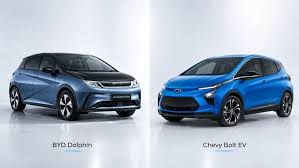
Second, the viral videos completely skip over the economics and ethics of the price tag. Social media is flooded with shock-value comparisons showing Chinese EV models costing thousands less than domestic vehicles. For example, the compact Dolphin EV retails in China for $14,000 while a standard U.S. entry-level like the 2026 Chevrolet Bolt costs around $30,000. A 15-second video clip isn’t going to explain the crucial nuances: the differences in crash-safety features, import tariffs, and murky environmental and labor conditions under which the lithium and critical minerals are mined. The massive price differential is the only thing viewers see and remember.
Third, these marketing campaigns whip up intense consumer expectations for vehicles that have a low likelihood of succeeding in the U.S. market anytime soon.. Does that phantom hype matter? It does if would-be buyers actively shy away from the perfectly capable electric cars on the market today because they are holding out hope for a dirt-cheap, heavily subsidized alternative down the line that may never arrive.
The Flip Side:
However, there is a fascinating flip-side to this digital marketing wave. Could the visibility of these untouchable foreign cars actually spur legacy domestic automakers to innovate faster?
Look no further than Ford CEO Jim Farley. After visiting China, Farley famously warned his board that the rapid advancements of Chinese automakers posed an existential threat to Detroit, reportedly muttering, “We are cooked.” The threat felt so tangible that Farley even had a Chinese-made Xiaomi SU7 flown from Shanghai to Chicago so he could personally drive it every day to study its software and manufacturing efficiency.
So, while legacy automakers are still trying to figure out how to profitably build smaller, affordable EVs for the masses (their Model T) pressure from global digital media is forcing them to move forward with partnerships for batteries and electric motors. It’s useful to recall, as partnerships go, that General Motors formed its monumental SAIC-GM joint venture with the Chinese back in 1997 and Tesla broke ground on its massive Shanghai Gigafactory back in 2019.
It is still is a monumental leap from building, staffing, and managing a physical automotive factory to simply talking about one. For decades, traditional car commercials relied on beautifully produced, cinematic footage of wide-open, traffic-free highways to sell us a dream of freedom. Now it’s the influencers on social media. The irony is that real collaboration happens on the factory floor, not just on a smartphone screen.