
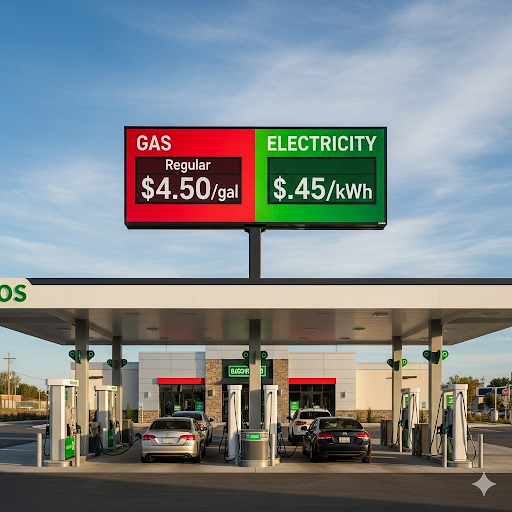
How do you incentivize drivers of gasoline vehicles to try an electric vehicle? Improbably, it’s at the gas station. The convenience and familiarity of the corner gas station has traction for conventional drivers who are cautious about the new tech. Significantly, it makes their transition to an electric vehicle easier because they experience less uncertainty. When they charge for the first time there’s likely to be someone on hand to answer questions. They see the usual options for window washing and tire checks. Maybe there’s a car wash too. All Drivers are Welcome at the Hybrid Gas Station. It’s a place for every driver.
Some of the biggest fuel suppliers like Exxon, and Shell are somewhat agnostic to the power source and have dipped their toe into the hybrid business. On the interstates, big service providers like Pilot J and Loves, have installed fast level 3 chargers alongside gas pumps. They received generous NEVI funds for the build out and the most recent revision of NEVI now puts gas stations first.
But, if NEVI funding helps the bigger stations and players what’s the status for hybrids at the Mom and Pop station?
Many of the corner stations are owned by fuel conglomerates but they also run a convenience store on site- nearly 80% of gasoline is sold at a convenience store. Net revenue depends on selling snack foods, beverages, and lottery tickets since there is said to be only a 3 to 5% margin on gasoline.
Leveling 2 vs. 3:
As electric vehicles become mainstream, station providers worry about “peak gas.” But how do you convince a gas station owner that it’s time to “go hybrid” today? R&S, in Tacoma Park, Maryland was the first gas station to make a full switch from gasoline to EV chargers in 2019. But they have a different model- all electric charging stations, and gasoline car repairs.
Putting in Level 3 fast chargers does not “pencil out” for Mom and Pop gas stations for a number of reasons. Level 3 charging requires extensive trenching, permitting, and a proximity to electrical transformers. The upfront cost can exceed $75,000 to $100,000 per station. So installing slower Level 2 charging stations is the alternative.
But Level 2 stations seem more attractive to gas station owners than drivers. On average they provide an electric car with 30-35 miles an hour, but the fill time varies with the car’s EVSE equipment. No motorist wants to be stuck at a gas station for an hour or two, unless there are businesses and activities close by.
That said, there are two innovations in EV charging that still make Level 2 charging a good choice for the hybrid gas station. They help during this transition period, and in due time, might encourage gas station owners to seek out Level 3 installations.
A Cable Hybrid:
The first Level 2 innovation is to install a BYOC (bring your own cord) centric charge system, similar to the ItsElectric model. In Europe, EV drivers are accustomed to carrying Level 2 cables that get plugged into a “charging post”. These posts are cabled either above or underground to an electrical subpanel with a 40 to 50 amp feed.
For a U.S.-gas station version, the gas station owner lends a BYOC to the customer, but just for that specific charging event. A BYOC is useful for the “last mile” charge, say in an EV charging desert. It also services the customer who only drives 30 or 40 miles a day. The model does double duty in an urban area with apartments or condominiums. If the gas station has a side area for parking, the BYOC gas station is the neighborhood hub to reserve overnight charging. Significantly, it’s a low-cost, fast way for a gas station owner to tip into hybrid operations.
A Buffered Hybrid:
The other promising technology for the convenience store/ gas station is a buffered battery. A company called Freewire went out of business, but it had a prescient solution that other companies are now improving upon, called microgrids. Freewire could deliver Level 3 charging without costly, high-power electricity upgrades. The stations were a hybrid: first they used large lithium battery packs, even recycled ones from cars. During the daytime these battery packs could recharge from the sun or windpower. Or, they could draw electricity from a 240 amp outlet. The battery backup wasn’t a perfect solution for high-volume locations, but again, the technology was ahead of its time. This solution delivered DC power to cars, so cars charged up faster.
All Drivers Welcome!
Either solution, battery buffering or bringing your own cable- helps pivot gas stations towards a hybrid fuel source.
The hybrid energy station is a win-win for a gas station owner, who is not sure of the timing- and needs to keep their business planted in gasoline sales for now. It addresses, for the short term, that locations do not have a quick solution for a Level 3 upgrade.
It’s also a win-win for the EV driver. A hybrid energy station means fewer charging deserts, and the security of knowing that there is a last-minute, last mile- charge. In an urban area, there’s a different benefit. The hybrid station can be the place to park overnight, or get a few extra miles when visiting a business nearby, say a restaurant or gym.
But the real win-win is for the driver of a gasoline vehicle. They finally get to see that electric vehicles are going mainstream. They get to watch how vehicles get charged and talk with owners on site. The hybrid gas station is a vital signal that change is happening and the gas stations are a welcoming place for every driver.