
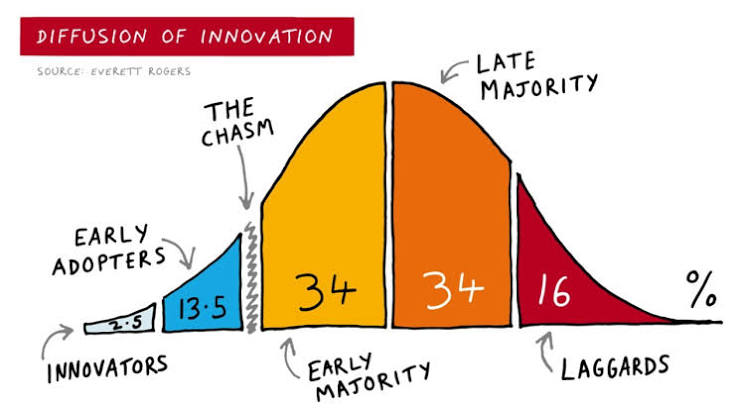
There’s a numbers problem when it comes to the diffusion of electric vehicles, at least in the United States. On the one hand, more than 720,000 new EVs and 354,000 used EVs were sold in the first three quarters of 2026. On the other hand, “no one” sees them.
These new and used EVs do not make a visual dent. It’s slightly better in California where over 16% of the new vehicles sold this year are EVs (source: Cox EV Market Monitor) and “ dirty white Teslas” pop up everywhere. Still, visuals are a problem for the diffusion curve, even there.
Here’s why: The average gasoline car is on the road today for 12+ years. About 55 M of our ~280 M light duty vehicles are bought, sold, or scrapped annually. Doing some back-of-the-napkin math, it would take 17 or 18 years, around 2042 to 2044, before the active fleet crosses 50% battery-electric.
If you care about EVs, the visual optics make a difference. The earliest EVs, the Leafs and Roadsters were driven by early adopters. This group tried out a technology that would rapidly obsolete, and they worked around the absence of public charging stations. These are fading concerns today, with about 18,000 Level 3 charging stations, and about 20 EV models that exceed 300 miles.
Why Does This Matter?
The problem is that gasoline drivers, the next group on the diffusion curve, do not realize how many EVs, and how many charging stations are available. They are not early adopters and certainly not actively seeking out this information.
The Industry Creates Its Own Complexity:
One way of spotting an electric vehicle is to clearly identify that it is an electric vehicle! We have written here how U.S. automakers are loath to do their unique EV branding. General Motors, for one, calls their electric car an E-Equinox and the gasoline version an Equinox. Ford produces an EV Mustang, and a gasoline one, and until recently, both versions of a F-150.
Tesla is the notable exception. They do not produce any gasoline cars, and Tesla vehicles have nearly instant recognition. Moreover, since they rarely tweak the styling, the cars on the road seldom look outdated (perhaps with the exception of the soon-to-be discontinued Cybertruck).
Visibility matters, because as Wharton professor Jonah Berger writes, people can imitate only when they can see what others are doing. Observability has a huge impact on whether products and ideas catch on.
Berger went on to demonstrate this in automotives (Contagious, p. 135-136). He and colleagues studied 1.5 million car sales. They found that when a neighbor bought a new car it influenced others to get one- perhaps one in eight. But In sunny cities where cars were more observable, like Miami and Los Angeles, the effect was the largest.
Beyond neighbors, how can people learn about new vehicle models? One method is to attend car shows, but that assumes an overall propensity to be searching.Showrooms, of course, are the logical place to see and test a new EV model. However most of them are filled with gasoline cars. The EVs on display are often the most expensive, bulky, or impractical ones. Dealerships do not improve the visibility problem.
The Rental Industry Create Additional Setbacks:
Probably the greatest disservice to EV diffusion has been auto-rental firms. On the one hand, putting a new vehicle in the rental fleet is a great way for would-be drivers to see an unique car and get comfortable with it. But in rental fleets, EVs have been a debacle. Customers don’t know how to think about distance in kilowatt hours, and they expect to find a gas station a block away from the rental return. There are legions of hand-wringing stories in the mainstream press about the hassles of an EV rental. They should not come as a surprise.
Leapfrog Elsewhere:
The U.S. is saddled with cars, ~280 M of them, that are mechanical, evolved from a 125 year-old breakthrough back when. China and other Asian countries leapfrog over this, because they do not have built an infrastructure tied to the gasoline car. Their diffusion curve looks radically different. It did not have to pander to early adopters who were wealthier, curious, and able to add an EV as their second or third household vehicle.
U.S. drivers simply lag on the diffusion curve. Young people should not, and if urban they like their trips in autonomous EVs from Tesla, Waymo or Zoox. But when it comes to their own vehicle, they are driving Grandma’s gasoline sedan, or the hand-me-down SUV that brought them back and forth to school.
We can’t ignore our 125 year history with mechanical devices… and we don’t draw attention to our EV fleet, say with blinking lights and fancy logos. So, at the end of the day we don’t distinguish EVs from the older vehicles on the road. But getting EVs noticed would be useful. Visibility is the jet fuel that propels the diffusion curve.