
At first glance, electric vehicles and diesel cars couldn’t be further apart. One runs on lithium-ion cells and software; the other burns heavy, soot-producing oil. Yet, ironically, it was the scandals and environmental limits of diesel that helped jump-start electric vehicles.
The Dieselgate Pivot:
Many people will recall “Dieselgate”, the 2015 coverup where Volkswagen (VW) cheated emissions testing to certify their diesel vehicles as low-emission. The reparations required VW to invest $2.0 billion over 10 years in Zero Emission Vehicle (ZEV) infrastructure. They set up a subsidiary called Electrify America with nationwide EV charging stations. EV America was a step forward and a step back for the EV industry. Many of the Electrify America charging stations were inoperable and gave EV charging a black eye.
Nonetheless, what Dieselgate accomplished in the U.S. was cementing the view that diesel was no longer a viable option for passenger transport. Diesel’s passenger car market share dropped below 1% following 2015 in this country. That helped funnel environmentally conscious consumers toward battery electric vehicles.
Long Before VW: The Search for Clean Fuels:
That said, the movement away from diesel started long before Dieselgate. In the 1990’s the EPA Clean Air Act Amendment and California’s Zero-Emission Vehicle (ZEV) program, issued novel mandates for Alternative Fuel Vehicles (AFVs). A main objective was to eliminate, or at least reduce, the public health risk from diesel’s toxic black smoke and fine particulate matter.
In reaction to the environmental rules, Detroit automakers experimented across three primary paths:
- Hydrogen fuel cell vehicles
- Liquefied (LNG) & Compressed Natural Gas (CNG) vehicles
- Battery Electric vehicles
The alternatives to “dirty diesel” were expected to cut smog, improve public health, and clean up city air.
The Rise and Fall of Natural Gas:
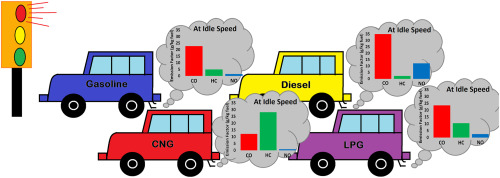
Of the three options, natural gas quickly outpaced hydrogen fuel cells. Hydrogen presented immense technical hurdles. And, ironically, a supply of natural gas (CH4) was needed to extract the hydrogen. CNG, on the other hand, was affordable, accessible, and ready to deploy immediately through existing city pipelines. So, for a short time, CNG was the winning AFV. It produced 80% to 90% fewer particulates and dramatically reduced carbon monoxide and smog-forming nitrogen oxides (NOx).
Automakers favored CNG because they could modify their lineup of gas cars to accommodate it.
- Ford produced CNG versions of its Crown Victoria sedan (a staple of police fleets) and the F-150 truck.
- General Motors built an array of natural gas vans and commercial trucks.
- Honda introduced the Civic GX in 1998 and partnered with FuelMaker Corporation to sell “Phill”—a home refueling appliance that compressed natural gas directly from a homeowner’s gas line.
Major transit providers, e.g., LA Metro converted massive portions of their buses to CNG (retiring their last diesel bus in 2011), as did municipal waste haulers.
Why CNG Loses the Market to Electric:
If natural gas was abundant, cheaper, and cleaner than diesel, why did it fail to win passenger transportation? And how did the electric car come to rise in popularity?
The answer comes down to global warming. Natural gas is fundamentally methane (CH₄)—a non-renewable fossil fuel. Unburned methane escaped during the gas extraction, transport, or compression remains in the atmosphere for an unfathomable length. These methane leaks go unnoticed and are hard to contain. And then, even at the tailpipe, these CNG vehicles continue to emit some carbon dioxide and NOx.
Recognition of greenhouse gas emissions spurred the search for other fuel choices here in the U.S. and rebounded the use of diesel, which was reformulated to burn cleaner. Elsewhere, in Iran, China, and parts of South America, CNG is still favored over diesel.
Why Diesel Looses the Market to Electric:
Here, in the U.S., as the price of diesel exceeds all previous records, fleet operators and freight haulers will once again be searching for AFV (alternative fuel) solutions. It will not be back to CNG. And, because of the weight of batteries and the lack of a super-fast national charging network electric powered trucks are not yet a solution. However, new companies are reimagining the future with autonomous diesel/battery hybrids.
The closer solution, the reformulation of diesel with domestic feed stocks, (so-called bio-diesel) is unlikely to be the long term answer. It doesn’t bring down cost and it has environmental impacts. The evidence is already in: LA Metro, which took the lead and converted its buses to CNG, now says it has fully committed to phasing out that fleet. They plan a 100% zero-emission electric bus fleet by 2030. As diesel gets new knocks, both hybrids and battery powered vehicles glide forward.
–