
There’s a wake up call coming for car makers, and it’s ringing straight from their smartphones. Imagine if they could market electric cars with the same bravado and sizzle as consumer electronics…specifically phones!
This past week, the new CEO of Apple, John Ternus, made product announcements that would be inimical to Detroit automakers. Apple’s key message was hardware and software designed from the ground-up to harmonize battery power. Among the announcements:
- The largest battery life increase in Iphone history for the Iphone 18 Pro Max
- A brand new split dual-battery system to accommodate the novel foldable phone and make it more purposeful. Thinner battery design to accommodate the fold.
- Rapid fast charging in just 15 minutes with a 60W wall adapter
- Better thermal management for batteries across most product lines (watches/earbuds/phones)
Consumer Electronics and Cars:
These announcements are seductive: first, they make the average consumer (like me!) crave the newest smartphone or wearable device. At the same time, they make the current technology you own seem obsolete. Apple raised the bar for marketing both cars and phones.
Imagine if car makers gave a similar keynote. Taking a cue from Apple’s 2026 announcements they would boast (note: A1 through A4 are hypothetical)
- A1): This year battery refinements improve vehicle range by 50 to 75 miles and achieve an industry average of 380 combined city/highway miles.
- A2) A new split dual-battery system conquers range-anxiety. A small secondary battery, the Extended-Range EV (EREV) pack, can be swapped in and out for longer road trips.
- A3) At Level 3 charging stations, the internal DCFC charger improves charging speeds by 20%.
- A4) Smarter thermal management means our vehicles perform better in extreme conditions, whether in hot summers or sub-zero winters.
Just a Battery on Wheels:
For now, these achievements remain aspirational. In the U.S., solid-state batteries are perpetually “just around the corner.” And, despite the importance of battery innovation, both Ford and G.M., have recently scaled back, sold or leased facilities dedicated to battery manufacturing.
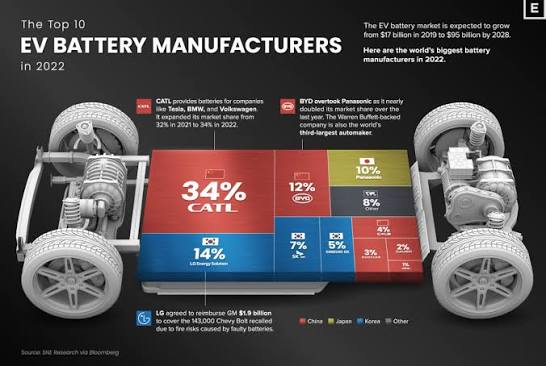
One of the reasons, more than a speculation, is that U.S. automakers are not vertically integrated with consumer electronics and software. They have not reckoned that the electric vehicle is a battery on wheels.
In China, the story is different and it helps explain how they jumped ahead to become the world’s largest producer of electric cars. While not household names in the U.S., two Chinese companies have deep roots in telecommunications/consumer electronics.
Bringing it home?
Xiaomi first made smartphones and consumer electronics. They turned the tables with the launch of their SU7 vehicle in 2024. Huawei, the largest supplier of telecommunications network gear, licenses their operating system to other Asian car makers. More recently, the vaulted consumer electronics company, Sony, formed a joint venture with Honda to make electric vehicles. The list goes on.
Even closer to home, while American consumers cannot buy an Apple car, Foxconn, the Taiwanese manufacturer of Apple phones, does has a mobility spinoff. In 2020 they partnered with Yulon Motor, and this past year Foxconn acquired the EV manufacturing arm.
Here’s the “jolt”: in the earliest days of car manufacturing, back when the U.S. had a decisive edge, 12 volt car batteries were termed “sprinters.” That’s because they were designed to dump a massive amount of electric current all at once to crank the engine. The 12 volt battery was designed to not drain down.
Today, the batteries in electric cars and smartphones are opposite in design. Whether lithium-ion or a different chemistry, the batteries sustain operations over the long haul, not a sprint. They are designed to be deep-cycled, cooled thermally, and managed by software.
For U.S. car companies, there’s a reckoning at hand. Do they want to be in the business of moving electrons in batteries, or remain staid and gradually obsolete? It’s a far-reaching issue because batteries power more than EVs. They are at the core of other 21st century innovations, like drones, robotics, and autonomous cars. Just thinking it’s time for them to pick up the phone.