
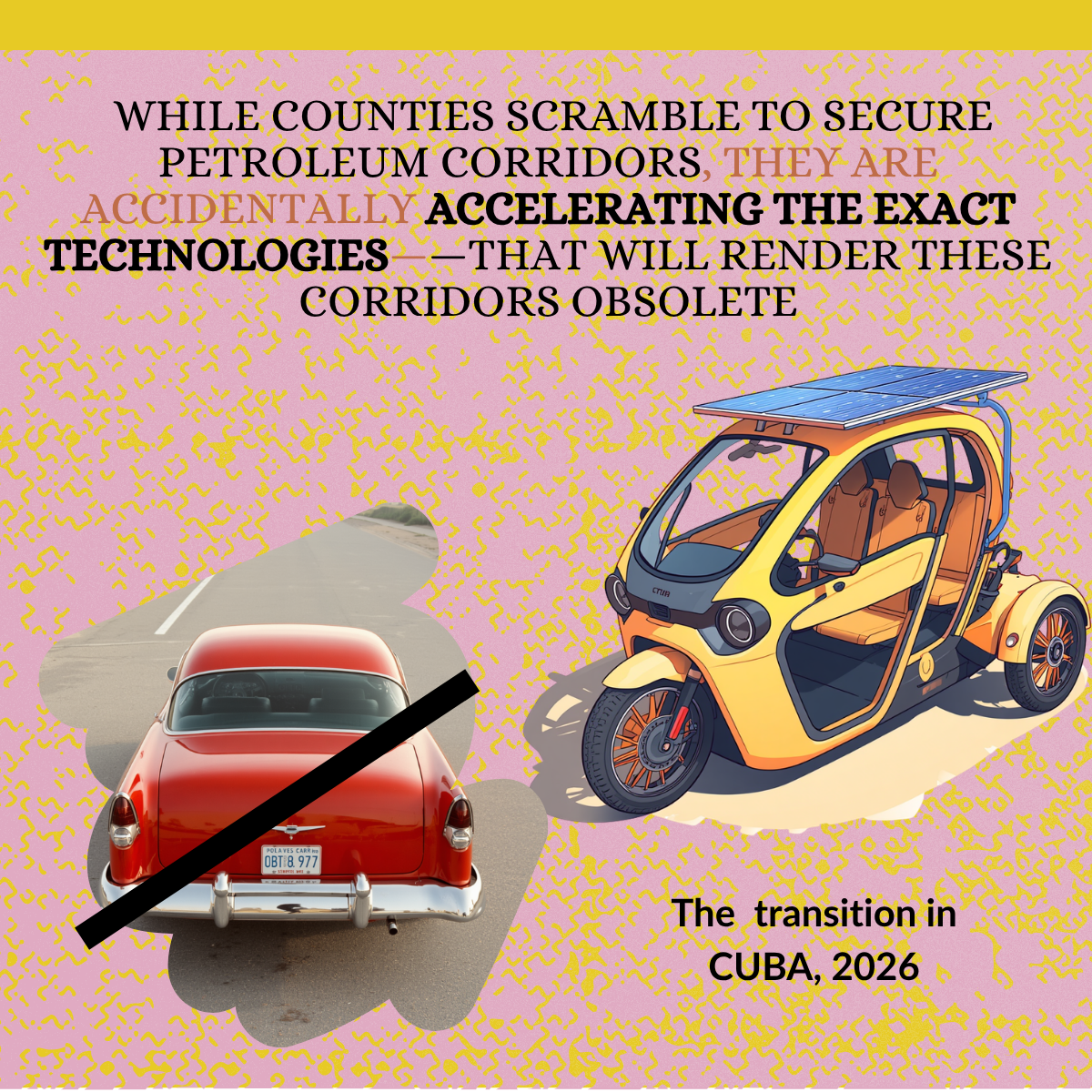
The war in Iran brings the ultimate irony: the longer the conflict endures, the faster it kills demand for petroleum products. Once shipping lanes open for good and gas prices reset, countries will be less reliant on Middle East sources. That’s because the transportation sector is finding new ways to power up and bypass supply-side choke points.
It won’t be the first energy reset. Prior to the second ‘Oil Shock’ of 1979, U.S. utilities mostly relied on imports of heavy crude oil. Recognizing their vulnerability, the utilities here (and elsewhere) switched gears. In the 1980s and 90s they reconfigured their plants to use domestic sources like natural gas, coal, and nuclear energy.
Today, mobility is experiencing a parallel course. It’s a ‘just-in-time’ moment for new technologies and new energy storage systems. Here is a sampling of new endeavors.
1. Burning up the Pump:
In Cuba, hit hard by shifting oil supply lines, the Associated Press reports that the country’s iconic vintage gas cars are increasingly being replaced by small electric trikes.These trikes, primarily from China are being deployed for trips from cargo deliveries and garbage collection to fixed-route city transit. Crucially, to mitigate island-wide electrical blackouts and reduce grid strain, these small vehicles are equipped with integrated solar panels. Unlike their 1950s cars, they keep the air clean and successfully bypass the need for gasoline.
2. Battery Swapps for Small & Large Vehicles:
The disruption is also breathing new life into a century-old idea: the battery swap. While the concept failed to take off in the 1910’s, in Israel, and even in early Teslas, it has gained explosive momentum in cities in India and Asia. Battery swaps make it convenient for the drivers of scooters, bikes, and other two and three wheel vehicles to get around, hire out their services, and bypass unsafe or unavailable home charging.
China has scaled the battery-swap farther and applied it to batteries of all sizes and configurations. The country’s expanding “Zero-Carbon Highway Corridors” feature highly automated swapping stations capable of replacing heavy-duty freight truck batteries in just minutes. This swap is also spreading to Europe. A company called Ample has launched modular battery swapping networks in Madrid and Tokyo. Designed to serve urban last-mile delivery vans and car-sharing fleets (such as Stellantis’s Free2Move fleet), the technology is designed to replicate the speed at a gas station refill.
3. BESS stores more energy than petroleum:
Battery Energy Storage Systems (BESS) require significant planning and capital to deploy, but BESS are still likely to be the first-place prize winner after the Iran conflict. Well before the war BESS were gaining speed because of the sustainable/low carbon economy and AI energy needs. In the U.S. battery recycler Redwood Materials launched ‘Redwood Energy,’ a platform to repurpose spent EV battery packs into low-cost, grid-scale stationary storage. In Europe, V2G grows: a German company Mobility House, offers drivers rebates on their energy bill if they agree to leave their electric car plugged into the grid for a defined number of hours each day.
China has an even longer track record of scaling battery enabled energy storage. Rather than feeding solar power directly into a volatile grid, Chinese commercial sectors favor massive solar canopies that feed localized battery banks. They install solar collectors on top of shopping malls, highway rest stops, and municipal parking structures. Globally, the solar carport market has surged past $2.5 billion, driven largely by state mandates and commercial retrofits aimed at securing energy independence.
4. Shifts in the Showroom
In Europe new and used car-buyers are also shifting the paradigm.The Iran conflict has given electric vehicle sales a definitive, security-driven boost. Battery-electric vehicle (BEV) registrations in Europe surpassed 1.24 million in the first half of the year. It’s a 33.7% year-over-year growth. Sales hit record highs in markets that historically showed slower adoption curves, such as Spain and Central Europe.
This sudden acceleration causes unanticipated business woes for legacy European auto makers like Volkswagen, BMW, and Stellantis. However, in the U.S., the automobile market did not follow suit. Sales of both gasoline and especially electric vehicles declined in the first quarter of 2026.
Coming Around to “Resets”
The longer the Iran conflict continues, the greater the opportunity for a structural “reset” with faster transition towards renewable sources. For some countries, like Cuba, it’s about self-reliance, economic sustainability, and just keeping the lights on. For others, like India, it’s about reinventing transportation that moves more people at the lower cost. In the U.S it’s a mixed bag, because while we import more oil for transportation than any other country, the U.S. is also a major exporter of light crude.
Patriotic U.S. consumers, who want to keep on driving but also feel the pinch at the pump, see it otherwise. They have not chosen an electric vehicle yet because they do not see it as an environmental choice and they don’t want a tech gadget. But the longer that gas prices stay high and international shipping is threatened, driving an EV may take on new purpose for them. The EV is a declaration of energy independence.